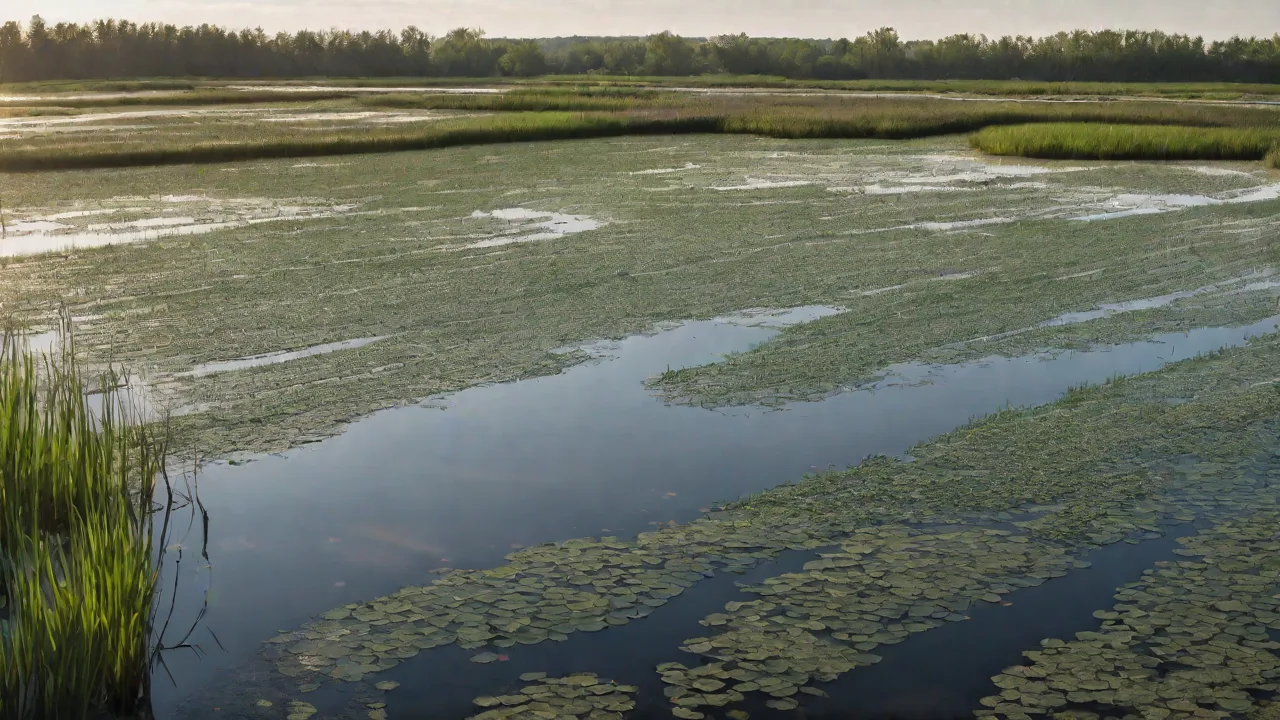
Wetlands as Natural Water Filtration Systems and Their Ecological Importance
Wetlands are vital ecosystems that serve as natural water filtration systems. They are wetlands such as marshes, swamps, and bogs that filter pollutants from...
2634 articles
Wetlands are vital ecosystems that serve as natural water filtration systems. They are wetlands such as marshes, swamps, and bogs that filter pollutants from...
The water cycle is a fundamental natural process that shapes our environment. It involves the continuous movement of water on, above, and below the Earth's...
drought conditions can significantly disrupt the natural balance of the water cycle, impacting ecosystems, agriculture, and human communities. Understanding...
The hydrological cycle, also known as the water cycle, is a fundamental process that moves water through the Earth's atmosphere, surface, and underground. This...
Urbanization has a significant impact on natural precipitation and runoff patterns. As cities expand, they alter the landscape, affecting how water moves...
Dams have played a significant role in human development by providing water for irrigation, hydroelectric power, and flood control. However, their construction...
The natural hydrological cycle, also known as the water cycle, is essential for maintaining life on Earth. It involves processes like evaporation...
The Hubble Parameter is a fundamental concept in cosmology that helps scientists understand how the universe is expanding. Named after the astronomer Edwin...
The Planck charge is a fundamental physical constant that plays a crucial role in our understanding of natural interactions at the quantum level. It is a...
The Significance of the Feigenbaum Constants in Natural Transition to Chaos The Feigenbaum constants are fundamental numbers in chaos theory, discovered by...
The Laplace constant, often denoted as α or k , plays a crucial role in understanding wave propagation and natural vibrations in various physical systems. Its...
The cosmic distance ladder is a series of methods by which astronomers measure distances to objects in space. It is essential for understanding the scale of...
The Pythagorean Theorem, discovered by the ancient Greek mathematician Pythagoras, is a fundamental principle in geometry. It states that in a right-angled...
The Euler characteristic is a fundamental concept in topology, a branch of mathematics that studies the properties of space that are preserved under continuous...
The Lambertian reflectance model is a fundamental concept in understanding how light interacts with surfaces. It describes surfaces that reflect light evenly...
The number pi , often called the Archimedes constant, is approximately 3.14159. It is a fundamental mathematical constant that appears in many areas of...
The Lambert W function, also known as the product logarithm, is a special mathematical function that has significant applications in various fields, including...
The Boltzmann constant, named after the Austrian physicist Ludwig Boltzmann, is a fundamental physical constant that plays a crucial role in the fields of...
The Cosmic Microwave Background (CMB) is a faint glow of radiation that fills the universe and provides a snapshot of the universe when it was just 380,000...
The Neperian logarithm, also known as the natural logarithm and denoted as ln(x), is a fundamental mathematical tool that helps us understand various natural...
The Feigenbaum constants are two mathematical values that reveal deep insights into the behavior of chaotic systems. Discovered by Mitchell Feigenbaum in the...
The gravitational constant, denoted by G , is a fundamental physical constant that plays a crucial role in our understanding of the universe. Its value...
Birds flying in flocks often synchronize their wingbeats, creating a mesmerizing display of coordinated movement. This phenomenon is not just visually...
Understanding how birds generate lift is essential for both biological studies and the development of bio-inspired flying machines. Computational Fluid...
Insects such as bees, locusts, and ants have developed remarkable aerodynamic strategies to navigate and coordinate within their swarms. These innovations not...
Albatrosses are renowned for their extraordinary ability to glide long distances over the ocean with minimal effort. Their impressive flight capabilities are...
Bats are remarkable creatures known for their agility and precision in flight. Two key adaptations that enable their impressive maneuvering are echolocation...
The Role of Natural Succession in Creating Wilderness Areas Natural succession is a fundamental ecological process that shapes the development of wilderness...
Natural parks and reserves play a crucial role in conserving biodiversity and protecting natural landscapes. Their development has been deeply influenced by...
The Influence of Invasive Species on Natural Succession Dynamics Natural succession is the process by which ecosystems change and develop over time. It...